MY TAKE
Last week was the climax, and this week things no longer look the same…
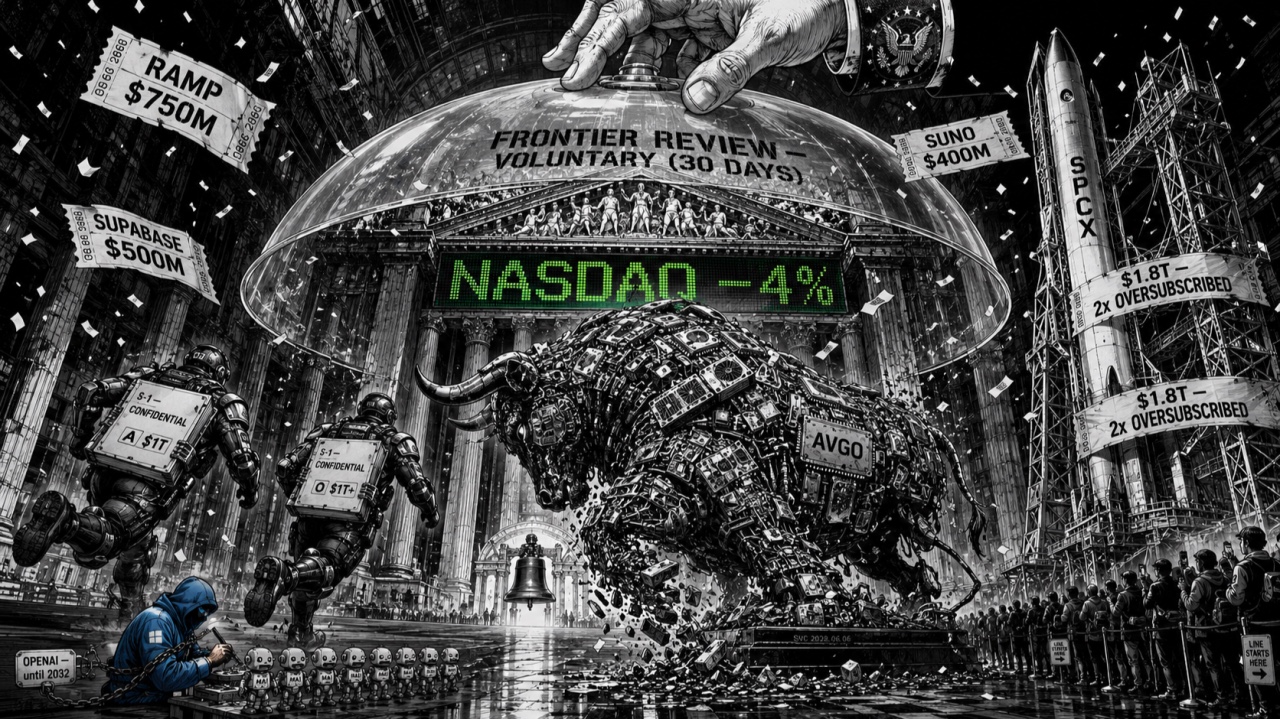
On Wednesday, Broadcom posted results that, in any normal year, would have been a party: $22.19 billion in revenue, net profit up 88% year over year.
Eighty-eight percent… Rick.
The stock sank 12.6% and dragged the Nasdaq to a 4.18% drop on Thursday, its worst session since April 2025.
The crime? Not raising its AI chip sales forecast. It held it. And holding it, when the price had already discounted an upgrade, was enough to wipe out hundreds of billions of market cap across the sector.
In AI, from now on, growing isn’t enough — you have to grow faster than what the market has already paid for in advance.
We can tie this to the week’s other big story. On Monday, Anthropic filed its confidential S-1, days after OpenAI did the same. On Thursday, SpaceX opened the roadshow for the biggest IPO in history: $75 billion at a $1.8 trillion valuation, with the books already two times oversubscribed. Three of the most expensive companies on the planet are racing toward the same public market in the same fall. And they’re doing it exactly in the week that market is flashing signals.
It’s no coincidence: when private money can no longer absorb you — no private round can handle a trillion-dollar valuation — going public stops being an option and becomes a financing necessity. But the public market doesn’t forgive losses the way venture capital did. Anthropic says it’s approaching its first profitable quarter; OpenAI burns on the order of $17 billion a year.
And above all of it, on Tuesday Trump signed an executive order creating, for the first time in the United States, a federal framework for reviewing frontier models. It’s voluntary, with no mandatory licensing, with government access up to 30 days before launch. But “voluntary” today means “mandatory within eighteen months” in nearly every regulatory precedent I’ve seen.
For Anthropic and OpenAI, about to ask institutional funds for money, this adds a new line to the risk section of the prospectus. A pension fund manager evaluating shares in an AI lab now also has to price the regulatory risk that its flagship product may require NSA review.
The way I see it, the Broadcom brake-check, the IPO race, and the Trump order all point toward a phase where “win at any cost and let the story pay for it” is over. What begins is the phase of proving margins to analysts, managing regulatory risk before regulators, and defending valuations in markets that can fall 4% in an afternoon.
My prediction for the next 90 days: the Broadcom correction won’t be the last. The first public S-1 — probably Anthropic’s, between July and August — will bring the first audited margin of a frontier lab, and that number will decide whether May’s euphoria was fair price or bubble.
And SpaceX, which prices on June 11, will set the thermometer: if its debut on the 12th goes well, the fall window swings wide open; if it disappoints, OpenAI and Anthropic will think twice. This week the market stopped applauding.
Now it asks questions.
If you want more detail, I’ll leave you with the minions… and if you enjoy the newsletter, I’d ask you to share it or comment. That’s how I reach more people.
Thanks for reading.
THE BOMBSHELL OF THE WEEK
Anthropic files its confidential S-1 near the trillion mark and turns the AI IPO into a three-way race with OpenAI and SpaceX
On June 1, 2026, Anthropic confidentially submitted to the SEC a draft registration statement (S-1) for an initial public offering, targeting a fall debut. It’s the third act — and the most serious — of the pre-IPO choreography this newsletter has been documenting since April: first the round leak, then the Series H close and the Opus 4.8 launch, and now official paper before the regulator. But what makes this move the bombshell of the week isn’t the filing itself: it’s that it lands inside a window in which three of the most valuable companies in the world are racing toward the same market.
Timeline of the week that sealed tech’s autumn:
- June 1: Anthropic confidentially files its S-1. It confirms that “the number of shares to be offered and the price have not yet been determined.” Lead banks: Goldman Sachs, JPMorgan Chase, and Morgan Stanley. Target debut: fall 2026. (Reminder: OpenAI had made an equivalent confidential filing in late May, aiming for September.)
- June 2: Trump signs an executive order on frontier-model review (see Power Moves). Microsoft opens Build by unveiling its in-house MAI model family (see Products).
- June 3: Broadcom posts record results but doesn’t raise its AI chip guidance.
- June 4: the Nasdaq falls 4.18%. The same day, SpaceX opens its IPO roadshow (see Power Moves and Money Talks).
The Anthropic numbers that are on the table (confirmed by Fortune and TechCrunch):
- Valuation near one trillion dollars, starting from the $965 billion of the May 28 Series H.
- Revenue run rate crossing $47 billion, versus roughly $9 billion at the close of 2025.
- $10.9 billion in projected revenue for the second quarter, per the documentation cited by Fortune, and the company says it’s approaching its first profitable quarter.
- On the other side, OpenAI: ~$122 billion raised at an $852 billion valuation in March, a run rate around $24 billion, projected losses of ~$14 billion in 2026.
Why it matters more than it seems. A confidential S-1 doesn’t make the audited numbers public: they’ll go public when both companies do their public filing (typically 4–8 weeks before the roadshow — meaning July-August). But registering fixes the calendar. From here on, two frontier labs will compete for the same institutional capital weeks apart, and they’ll do it in a market that this very week has shown — with Broadcom — that it no longer gives away multiples.
The signal: the AI war has moved from benchmarks to the capital markets. The next battlefield isn’t SWE-bench: it’s the audited income statement fund managers will see. And on that terrain, whoever has the better margin — not the better model — sets the price.
POWER MOVES
Trump signs the first frontier-model review order of the post-Biden era (June 2)
On June 2, Trump signed the executive order “Promoting Advanced Artificial Intelligence Innovation and Security.” It creates a — voluntary — framework under which developers can submit their frontier models to the government for cybersecurity review up to 30 days before public launch, under confidentiality agreements. The NSA determines what counts as a “covered frontier model”; agencies have 60 days to stand up the evaluation system. The text is explicit that it creates no licensing or mandatory preauthorization. The operator’s read: it’s the first federal AI model oversight mechanism since the dismantling of the Biden safeguards, and “voluntary” is historically the first step toward “mandatory.” For Anthropic and OpenAI, with IPOs in motion, this goes straight into the risk section of the prospectus.
SpaceX opens the biggest roadshow in history: $75B with demand for double (June 4)
On June 4, SpaceX kicked off the institutional roadshow for its IPO: a $75 billion target at $135 per share, a $1.8 trillion valuation. As of June 5 the books were two times oversubscribed — roughly $150 billion in demand for $75 billion available — and between 25% and 30% of the shares are reserved for retail, unprecedented for a mega-cap. Expected pricing: June 11; first trading day: June 12 on Nasdaq, ticker SPCX. It’s not a hire, but it’s the financial power move of the decade: the largest public listing ever attempted, and the thermometer that will dictate whether the fall tech IPO window opens or closes for everyone else.
Pichai publicly admits Google is “a bit behind” in agentic coding
On the Hard Fork podcast, Sundar Pichai openly acknowledged that Google is running “a little behind” in agentic coding. For Alphabet’s CEO, admitting a competitive lag in the hottest category of the moment is a strategic rarity: either it’s expectation management before a big launch (the imminent GA of Gemini 3.5 Pro fits), or it’s an honest concession that Anthropic and OpenAI have outplayed Google in the developer segment. Either way, it marks where Google will concentrate its artillery over the coming quarters.
MONEY TALKS
The week of the megarounds: more than $3 billion in a single batch
The week of June 5 was, per Crunchbase, the busiest week of 2026 for megarounds. The concrete figures, all reported within the window:
- Ramp — $750 million in funding, $44 billion valuation. Leads: Iconiq, GIC, and Ontario Teachers’. The spend-management fintech keeps scaling its multiple against the tide of the rest of SaaS.
- Supabase — $500 million Series F, $10.5 billion valuation ($10 billion pre-money). Lead: GIC; with Stripe, Georgian, and Salesforce Ventures. It doubled its valuation in 8 months (it came from $5 billion in October 2025). The insider data point that doesn’t make headlines: around 60% of new Supabase projects are generated by AI tools (Claude Code, Codex), and its developer base has nearly doubled to close to 10 million.
- Helion (fusion) — $465 million Series G, $15.5 billion post-money valuation. Lead: Thrive Capital.
- Suno (AI music) — $400 million Series D, $5.4 billion valuation. Lead: Bond.
- In the same batch: Generalist AI (robotics, $400M at $2B), AlphaSense ($350M at $7.5B), Impulse Space ($500M), and NewLimit (longevity, $435M).
The signal: private capital hasn’t cooled at all at the growth stage; what has changed is that exits are no longer bigger rounds, but the public market. Money is pouring into the tooling layer (Supabase, Ramp) and the energy layer (Helion) that AI needs, while the frontier models head for the exit door onto the trading floor.
Flourish: $500 million for “brain-inspired” AI with Jeff Bezos behind it
Flourish, a New York startup pursuing AI architectures inspired by the biological brain — an alternative to transformers — raised $500 million in its initial round, with Jeff Bezos, Lux Capital, and Google Ventures among the investors (no valuation publicly disclosed). It’s a patient-capital bet that a post-transformer paradigm exists before it’s even clear there is one. That Bezos is putting personal money into an architectural competitor to the current orthodoxy is, in itself, the signal: the big fortunes are starting to hedge against the possibility that the dominant architecture hits a ceiling.
Closing context from the prior week: Cognition (Devin), $1B at ~$25-26B (May 27)
Just outside the window by two days, but relevant for reading this week’s coding megarounds: Cognition, the maker of Devin, closed $1 billion on May 27 at a $25–26 billion valuation, with a declared ARR of $492 million and 10x growth in enterprise usage so far this year. Leads: Lux Capital, General Catalyst, and 8VC. It’s the thermometer of appetite for autonomous coding that explains why Microsoft, Google, and Anthropic are fighting over that same segment this week.
PRODUCT SECRETS
Microsoft Build 2026: seven in-house models and a message for OpenAI (June 2-3)
At Build, Microsoft unveiled its complete MAI family. Confirmed on the official blog: MAI-Thinking-1, its first reasoning model, with 35 billion active parameters and a 256K window; MAI-Code-1, an efficient coding model for GitHub; MAI-Voice-2 (15+ new languages), MAI-Image-2.5, and MAI-Transcribe-1.5 (43 languages). Available on Azure and also through third parties (Fireworks, Baseten, OpenRouter). Plus, platform: Microsoft IQ (an enterprise context layer), Microsoft Scout (a personal work agent), and the Surface RTX Spark Dev Box, capable of running 120-billion-parameter models locally. The competitive implication isn’t in any headline: Microsoft remains contractually tied to OpenAI until 2032, but it just demonstrated it is building and deploying its own model stack inside Copilot. It’s a dependency reduction executed in broad daylight, the same week its partner prepares its IPO.
Google’s Gemini 3.5 Pro, at the gates of general availability (June 6)
Announced at Google I/O (May 19), Gemini 3.5 Pro was still in limited preview as of June 6, with general availability described as imminent. Headline specs: a 2-million-token context window, a “Deep Think” reasoning mode, and full multimodality. Pricing estimated around $15 per million input tokens and $60 output — roughly 10 times the cost of Gemini Flash — with initial rollout in the consumer Pro ($20) and Ultra ($250) plans. If the Pro version extends to coding and agents the improvements Flash already showed, it forces Anthropic and OpenAI to revisit their enterprise pricing right in the middle of the IPO window. Pichai’s admission that Google is “behind” in agentic coding is the best clue to how hard they intend to push with this launch.
Anthropic expands Glasswing and debuts Partner Hub: the quiet channel (June 2-3)
In early June, Anthropic expanded Project Glasswing and added a Services Track and the Claude Partner Hub. It’s not a model launch, but strategically it weighs more: Anthropic is building the certified partner channel that will let it scale Claude Code into large accounts without ballooning its direct sales team — the answer to Salesforce’s AppExchange model, but for AI coding. It’s exactly the kind of recurring-revenue, low-marginal-cost infrastructure an IPO committee wants to see in the prospectus.
REAL NUMBERS
Tech layoffs, in data + context + implication format:
- 38,242 layoffs announced in the tech sector in May alone, the highest monthly figure since August 2024, per Challenger, Gray & Christmas (reported by Bloomberg on June 4). So far in 2026: 123,653 cuts, 65% more than the same period in 2025. Implication: this isn’t a recession — many of these companies are growing revenue; it’s a systematic transition of spend from human headcount to AI compute. The “layoff with growth” is the new normal.
Real revenue of the big players (run rate and burn):
- Anthropic: run rate crossing $47 billion; ~$9 billion at the close of 2025; $10.9 billion projected for the second quarter; approaching its first profitable quarter.
- OpenAI: run rate ~$24 billion; ~$17 billion in annual burn; projected loss of ~$14 billion in 2026; positive FCF not expected until 2029.
- Cognition (Devin): $492 million ARR, 10x growth in enterprise usage in 2026.
- The data point almost nobody crosses: OpenAI has a lower run rate than Anthropic and, even so, a higher target IPO valuation. If public markets demand a credible path to EBITDA — and this week’s reaction to Broadcom says they do — that premium is the first thing that gets adjusted.
Market, numbers from the June 4 session:
- Broadcom: -12.6% despite beating on revenue ($22.19B) and boosting profit 88%, for not raising its AI guidance. Nasdaq: -4.18%, worst session since April 2025. Micron: -17%, AMD: -12.6%, and Intel: -9% over two days. Implication: the AI chip thesis was overbought; it took just one leader not raising its forecast to erase market cap in a chain reaction.
THE DRAMA
Broadcom beat expectations and still sank: the first serious warning to the AI chip thesis (June 3-5)
Timeline: Broadcom reported on June 3 revenue of $22.19 billion (versus $22.27 billion estimated) and net profit of $9.31 billion (+88% year over year). The “crime” wasn’t missing: it was not raising its 2026 AI chip sales forecast (it held it at “more than $100 billion”) and giving Q3 AI guidance ($16 billion) below the estimate ($17.2 billion). Result on June 4: Broadcom -12.6%, Nasdaq -4.18%, and contagion to Micron (-17%), AMD (-12.6%), and Intel (-9%). In the background, Alphabet — which weeks earlier had briefly overtaken Nvidia in market cap — logged its fourth consecutive weekly decline while trying to raise an additional $85 billion. Estimated impact: it’s the first time in the cycle the market punishes an AI winner for not outdoing itself. It marks the psychological ceiling of “everything goes up” and reorders risk ahead of the fall IPOs.
OpenAI launches Dreaming V3: memory that rewrites itself and an incomplete audit trail (June 4-5)
On June 4, OpenAI rolled out Dreaming V3 to Plus and Pro users in the US: a memory system that updates itself in the background, synthesizing past conversations without the user asking. OpenAI states recall accuracy rises from 41.5% (2024) to 82.8% (2026). The non-obvious drama: memories are stored separately from chat logs, so deleting a conversation doesn’t delete the memories derived from it — you have to delete both, and even then, records of deleted memories can be retained for up to 30 days. TechTimes sums it up as an engine that “rewrites personalization and limits the audit trail.” Estimated impact: in the very week of Trump’s executive order on AI transparency, the launch moves in the opposite direction, and it opens a European regulatory front (GDPR, right to be forgotten) that hasn’t yet been audited. For a CTO deploying ChatGPT Enterprise, it’s a new question to ask the compliance team.
THE WEEK AHEAD
- Monday, June 8 — WWDC 2026, keynote at 10:00 PT (Apple Park). Expected: iOS 27, iPadOS 27, macOS 27, watchOS 27, and visionOS 27, with AI — and the long-promised revamped Siri — as the central thread. Why it matters: it’s the first WWDC with John Ternus already designated as incoming CEO (effective September 1); how Apple positions its AI defines the hardware strategy he will run. If Siri gets postponed again, that will be the story.
- Thursday, June 11 — SpaceX prices its IPO. The number that determines whether the $1.8 trillion valuation holds. Why it matters: it’s the market-appetite thermometer for the entire queue of fall tech IPOs (OpenAI and Anthropic included).
- Friday, June 12 — SpaceX’s first trading day (SPCX, Nasdaq). The most watched debut of the decade. A good first day swings the window wide open; a stumble chills it for everyone.
- This week (pending) — general availability of Gemini 3.5 Pro. Described as imminent. If confirmed, it forces a pricing response from Anthropic and OpenAI right in the IPO window.
- Broadcom hangover and AI semiconductor watch. After the June 4 drop, any comment from Nvidia, AMD, or Micron will move the sector. Why it matters: if the correction spreads, it reprices the risk of the entire ecosystem right before the roadshows.
- Week zero of S-1 leaks. The public prospectuses of OpenAI and Anthropic aren’t expected until July-August, but metrics usually leak earlier via bookrunner banks to Bloomberg and the WSJ. Watch for any audited margin number.
REFERENCES
-
Fortune - Anthropic confidentially files IPO at $965B (Jun 1, 2026)
-
White House - EO “Promoting Advanced AI Innovation and Security” (Jun 2, 2026)
-
Roll Call - voluntary cyber reviews for advanced AI (Jun 2, 2026)
-
Yahoo Finance - SpaceX IPO record $75B oversubscribed (Jun 5, 2026)
-
Bloomberg - SpaceX $75B IPO draws more orders than shares (Jun 5, 2026)
-
CNBC - Microsoft & Google take on Anthropic & OpenAI in coding models (Jun 1, 2026)
-
TechCrunch - Supabase doubles valuation to $10.5B (Jun 5, 2026)
-
TechCrunch - Cognition raises $1B at $25B pre-money (May 27, 2026, context)
-
TechTimes - OpenAI Dreaming V3 memory / audit trail (Jun 5, 2026)
-
Bloomberg - US tech sector announces most job cuts in nearly two years (Jun 4, 2026)