MY TAKE
Last week I closed by predicting that, for the first time in years, Anthropic could surpass OpenAI in absolute valuation.
I didn’t expect the prediction to come true in seven days…
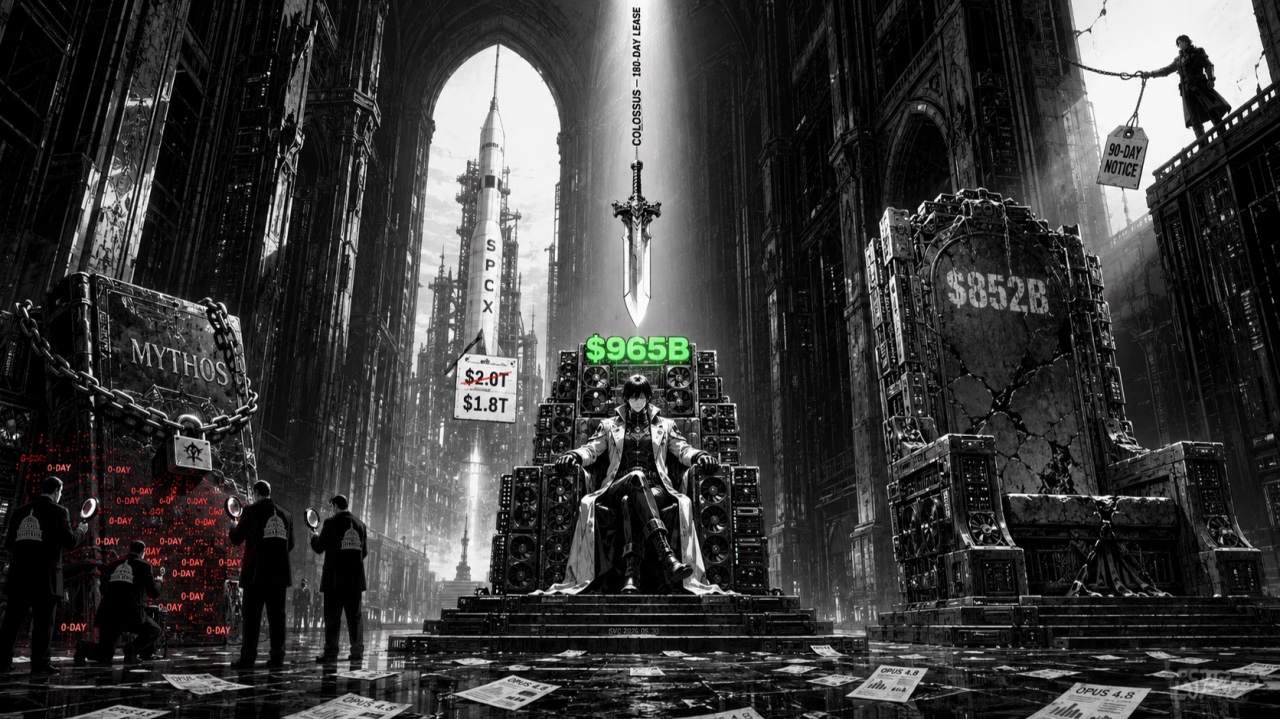
This Thursday, it closed its Series H: $65 billion at a post-money valuation of $965 billion, above OpenAI’s $852 billion. Number two became number one. And it did so, on top of that, by launching a new model (Claude Opus 4.8) the same day.
Amodei sure knows how to dance the tango.
But all that glitters is not gold. Let me explain.
SpaceX’s S-1 prospectus says Anthropic has committed to paying a monthly fee — $1.25 billion a month (there are months I don’t make that) — through May 2029.
Some $45 billion that anchors a good part of SpaceX’s revenue story heading into its IPO. On Thursday, Elon Musk posted on X that this is false: “it’s a 180-day lease with mutual cancellation on 90 days’ notice.”
Let’s set aside who’s lying — I get into that in The Drama below. What’s relevant for you is this: the most valuable lab in the world trains its next generation of models on Colossus, the data center of a direct competitor who just publicly declared he can reclaim that capacity with three months’ notice. That is the most dangerous infrastructure dependency I’ve ever seen documented in a filing. If I were an investor on the SpaceX roadshow, that would be my first question. If I were an Anthropic enterprise customer, my second.
And then there’s the other thing. This week Anthropic detailed the results of Project Glasswing and its Mythos model: a system capable of autonomously finding and exploiting vulnerabilities that had stayed hidden for decades — a 27-year-old flaw in OpenBSD, a 16-year-old one in FFmpeg that 5 million automated test runs never caught, and the ones we don’t know about…
Anthropic itself writes, in so many words, that “no company — including Anthropic — has developed sufficient guardrails to prevent these models from being used maliciously.”
In short: no Mythos Preview for us.
What arrives “in weeks” is a version with safeguards, via a future Opus (we’re already at 4.8). Anthropic has built the best cyber weapon on the market and decided it’s too dangerous to sell. It’s a responsible move. It’s also a confession that the capability frontier and the safety frontier no longer travel together — and that Congress, and possibly the orange one, is about to reach in.
Why am I telling you this?
Salesforce posted +205% on Agentforce, beat on revenue and profit, and the stock is still down 33% on the year. Perfection is already in the price; what moves the needle is the risk behind the perfection. And the risk behind Anthropic has a first and last name: Colossus and Mythos.
Anthropic is today in the strongest position of its history and, simultaneously, the most fragile. Strong because it has capital ($965 billion), talent (it just signed Karpathy), product (Opus 4.8) and, at last, margins. Fragile because its infrastructure depends on an enemy, its best model is a regulatory liability, and its valuation prices in an IPO that doesn’t exist yet. My prediction for the next 90 days: Anthropic will announce IPO investment banks before August and freeze the secondary market in its shares.
And I think we’ll see the first negative headline about the Colossus dependency — arriving before SpaceX prices on June 11.
Last week the oligopoly’s betting closed. This week the first hand was dealt. But the player who’s winning is holding two cards he doesn’t control.
Now, if you want to keep going, I’ll leave you with my minions.
THE BOMBSHELL OF THE WEEK
Anthropic overtakes OpenAI: closes $65B at a $965B valuation and ships Opus 4.8 the same day
On May 28, 2026, Anthropic executed the second act of the pre-IPO choreography this newsletter has been documenting since April. In a single day: it announced the close of its Series H, became the most valuable AI startup in the world, and launched a new frontier model. Three headlines any company would have spaced across a quarter, compressed into 24 hours.
The numbers, confirmed in Anthropic’s own release:
- $65 billion raised in the Series H.
- $965 billion post-money valuation. For comparison: OpenAI was valued at ~$852 billion. It’s the first time in history that Anthropic is worth more than OpenAI.
- Of the $65 billion, ~$15 billion are prior commitments from hyperscalers (including $5 billion from Amazon). This week’s net-new primary capital therefore hovers around $50 billion — an absorption of private capital without precedent in a single round.
- Run-rate revenue crossed $47 billion “earlier this month,” per Anthropic. Three months ago that figure was around $14 billion. Multiplying it by more than three in a quarter is the data point that justifies — or doesn’t — the valuation premium.
Context from the previous round: a week ago this same deal was being reported at $30 billion at more than $900 billion. It closed considerably bigger: $65 billion at $965 billion. The round grew during its own closing process — a sign of oversubscription.
The cap table is the message. Co-leads: Altimeter, Dragoneer, Greenoaks, and Sequoia. Also co-leading: Capital Group, Coatue, D1, GIC, ICONIQ, and XN. And entering: Blackstone, Brookfield, Fidelity, Jane Street, Lightspeed, MGX, T. Rowe Price, Temasek, DST Global, General Catalyst, Insight Partners… It’s a list of sovereign funds and crossover funds that buy pre-IPO positions and hold through the public listing. But the strategic detail is in another category: Micron, Samsung, and SK hynix enter as “strategic infrastructure partners.” The three largest memory manufacturers in the world taking equity in the lab. That’s not a software round; it’s vertical integration of the HBM memory supply chain ahead of the IPO. (I break it down in Power Moves.)
The product, the same day. Claude Opus 4.8 shipped on May 28. What’s verified: 74.2% on Terminal-Bench 2.1 (+8.4 points over Opus 4.7), improvement on SWE-Bench Pro, and — the data point that matters to any engineering team — four times less likely than its predecessor to let defective code through. Fast mode is 150% faster and costs three times less than the previous generation. The headline feature, “dynamic workflows” in Claude Code, coordinates hundreds of subagents in parallel for tasks at full-codebase scale (rewriting an entire application in another language). Pricing unchanged: $5/$25 per million tokens (input/output). (Competitive analysis in Product Secrets.)
The third, quieter headline: Mythos. The same day, Anthropic confirmed that Mythos-class capability — its offensive cybersecurity model — will arrive “in the coming weeks” for all customers, with safeguards, via an upcoming Opus. (The critical nuance — that Mythos Preview will NOT be released — and the regulatory storm it has unleashed, in The Drama.)
The signal: the temporal compression is once again deliberate and once again points to one thing: the S-1. Anthropic needed three documentary proofs for a credible fall IPO: Wall Street anchor capital (the crossover funds on the cap table), unit economics (the $47 billion run rate and finally positive operating margins), and a compute/supply-chain moat (the memory manufacturers as investors). All three arrived on May 28. What I called “the covert roadshow” a week ago now has an IPO-grade cap table, a presentable P&L, and a hardware narrative. All that’s missing is the starting flag. My bet stands: banks announced before August, IPO in the fall.
POWER MOVES
The memory oligopoly buys into Anthropic: Samsung, SK hynix, and Micron join the cap table
The most underrated executive move of the week isn’t a hire: it’s who appears on the Series H investor list. The three largest memory manufacturers on the planet — Samsung, SK hynix, and Micron — have taken equity positions in Anthropic as “strategic infrastructure partners.” It’s the first time all three enter an AI lab simultaneously. The read: the bottleneck of the next phase isn’t raw compute (GPUs), it’s the high-bandwidth memory (HBM) that feeds those GPUs. By putting all three HBM suppliers on its cap table, Anthropic secures priority memory allocation — the scarcest resource of 2026–2027 — and, along the way, aligns the incentives of those who could sell to the competition. For OpenAI and xAI, which depend on the same three suppliers, this is an uncomfortable signal: the rival has taken a seat at the supply table. The signal: the AI war is moving from “who has more GPUs” to “who has locked up the HBM that makes them run,” and Anthropic just bought a front-row seat. (Anthropic — Series H )
BILL brings back its founding CTO: the “rebuild the engine” pattern in the middle of an AI pivot
BILL Holdings (NYSE: BILL) announced on May 26 that its CTO, Ken Moss, is leaving (effective June 30) and that Eric Chan — founding engineer and the company’s first CTO, 19 years in the house — returns to the role. The Chief Customer Officer, Sarah Acton, departs simultaneously. The company explicitly framed it as accelerating toward being “an AI-native company.” The pattern is recognizable to anyone who’s lived through a technical restructuring: when you reinstate your founding technical voice during an AI pivot, you’re not iterating the product architecture — you’re tearing it down and rebuilding. Chan has the institutional architectural knowledge a hired CTO can’t replicate. The simultaneous exit of the CCO suggests the customer-success function is being reorganized under the logic of the new platform, not the old seat-based SaaS one. The signal: watch for a platform-rebuild announcement in H2 2026. When a public company brings back the founder-engineer, the next chapter is a “rewrite,” not a “refactor.” (BusinessWire · SEC 8-K )
CapitalG (Alphabet) leads OpenRouter: Google funds the layer that routes traffic away from Google
OpenRouter closed on May 26 a $113 million Series B at a $1.3 billion valuation, led by CapitalG, Alphabet’s growth fund. Participants include NVentures (NVIDIA), ServiceNow, MongoDB, Snowflake, and Databricks Ventures; a16z and Menlo return. The company processes 25 trillion tokens per week (5x in six months), with 8 million users and access to 400+ models. A year ago it raised $40 million at ~$547 million. The power move isn’t the size: it’s that Alphabet is funding the neutral routing layer that sends enterprise traffic to the best model for each task — which often isn’t Gemini. It’s an explicit hedge: if the model landscape stays fragmented (the most likely short-term outcome), OpenRouter becomes the default enterprise access point, and Google prefers holding equity in the tollbooth even if that tollbooth diverts cars from its own highway. That NVIDIA, Databricks, Snowflake, and ServiceNow are all on the cap table confirms multi-model routing is now critical infrastructure, not a niche tool. The signal: the giants are no longer betting on “their” model; they’re betting on controlling the layer that decides which model wins each query. (TechCrunch )
MONEY TALKS
SpaceX trims its IPO valuation from $2 trillion to $1.8 trillion — the roadshow starts June 4
Bloomberg broke on May 29 that SpaceX has lowered its IPO valuation target: from “above $2 trillion” to “at least $1.8 trillion.” The fundraising target (~$75 billion) holds. It’s a cut of more than $200 billion in the valuation floor, following consultations with advisors and investors during pre-marketing book-building. The calendar, confirmed this week: roadshow from June 4, pricing on June 11, Nasdaq debut under ticker SPCX on June 12. At $1.8 trillion on roughly $18.67 billion in annual revenue, the multiple falls to ~96x sales (from ~107x at $2 trillion): still historically extreme, but the cut indicates the bankers found real resistance. The signal: the trim is the first hard data point showing that not even the biggest IPO in history escapes the market’s new discipline. Watch for the S-1 amendment before June 4: if they also cut the size of the raise, that would be the true signal about institutional appetite. (Benzinga )
Cognition (Devin) raises $1B at a $26B valuation: 53x ARR and 50% monthly growth
Cognition AI closed on May 27 more than $1 billion at a $26 billion post-money valuation ($25 billion pre-money), co-led by Lux Capital, General Catalyst, and 8VC, with Founders Fund, Ribbit Capital, and Atreides participating. Eight months ago it was worth $10.2 billion: a 2.5x step-up. The disclosed data: $492 million in revenue run rate and enterprise usage of Devin (its autonomous software engineer) growing 50% month over month for six consecutive months. Cognition itself claims 90% of its code is now written by its own AI. At $26 billion on $492 million of ARR, the multiple is ~53x — double Anthropic’s (~20x). The presence of Ribbit (a fintech specialist) alongside Founders Fund suggests Cognition is preparing to expand from developer tooling into automation of regulated workflows (legal, finance, compliance). The signal: if the 50% monthly growth and 90% self-written code hold up in an S-1, Cognition would have a margin profile structurally unlike any previous software company. It’s the most operationally verifiable bet of the week — and the most expensive per unit of revenue. (TechCrunch )
Tensormesh, $20M: AMD, NVIDIA, and CoreWeave invest together in making inference cheaper
Small round, enormous signal. Tensormesh announced on May 27 $20 million ($24.5 million total) from AMD Ventures, CoreWeave, and NVentures (NVIDIA) — three entities that compete directly in compute supply — plus Valley Capital and Laude. The product: a KV-cache-based inference layer that eliminates redundant GPU compute and promises up to 10x reduction in latency and GPU spend. That the three largest compute providers co-invest in the technology that erodes their own per-GPU pricing is the confession of the week: the reduction of inference cost is now inevitable, and they’d rather understand it (and control it) from inside than have it arrive from outside. The signal: the “AI infrastructure trade” has a silent counterweight — every advance in inference efficiency is revenue that NVIDIA, AMD, and CoreWeave stop capturing. Investing in Tensormesh is, at once, competitive intelligence and defensive positioning. (BusinessWire · SiliconANGLE )
PRODUCT SECRETS
Claude Opus 4.8: the 41-day cycle is the weapon, not the benchmark
Anthropic launched Opus 4.8 on May 28, only 41 days after Opus 4.7. That cadence is the real news. The verified figures: 74.2% on Terminal-Bench 2.1 (+8.4 points), improvement on SWE-Bench Pro, and four times less likely to let flawed code through. Fast mode is 150% faster at a third of the previous cost. The new feature — “dynamic workflows” in Claude Code, in research preview — coordinates hundreds of subagents in parallel for full-codebase-scale migrations, from kickoff to merge. No other frontier lab has published anything structurally equivalent. Flagship customer cited: Bridgewater, which highlights the model’s “tendency to proactively flag problems in the inputs and outputs of an analysis — something other models missed.” Competitive implication: a 41-day iteration cycle destabilizes any rival with 6-week QA and security review processes — they arrive perpetually one generation behind. The pressure is no longer just model quality; it’s release velocity. (SiliconANGLE · GitHub Changelog — Opus 4.8 in Copilot )
Mistral launches “Vibe” and moves into industrial AI: Airbus, BMW, and ASML
While Silicon Valley was watching Anthropic, Mistral held its AI Now Summit in Paris on May 28 with the most ambitious play by a European lab in years. Two heavyweight announcements: (1) Vibe, a rebrand and expansion of Le Chat into a unified agentic platform — “one agent for work and code” — with asynchronous remote agents running in cloud sandboxes; its direct answer to Claude Code and Cursor. (2) Mistral for Industrial Engineering: a stack combining its LLMs with physical simulation (via the acquired Emmi AI), with Airbus, BMW Group, and ASML as launch customers. Competitive implication: Mistral is executing a two-lane strategy. The consumer/developer lane (Vibe) competes head-on with Claude.ai , ChatGPT, and Cursor. The industrial lane has no direct competitor — no lab has combined frontier LLMs with physical simulation for aerospace and automotive at this scale. For European enterprises, sovereignty (French infrastructure, GDPR-native) plus industrial AI creates a genuine moat that pure APIs can’t match. (Mistral — AI Now Summit · VentureBeat )
Apple pre-WWDC: the subdomain pointing to a Google-powered Siri
On June 8 Apple opens WWDC (keynote confirmed by Apple itself). This week’s signal: the subdomain genai.apple.com surfaced on May 24–25 — the marketing site for Apple’s AI brand — and on May 28 MacRumors reported that Apple will position on-device AI as a privacy differentiator against cloud-dependent competitors. This week’s reports converge on the redesigned Siri leaning on a Google model for heavy reasoning, with processing via Private Cloud Compute. Competitive implication: it would be the first time a frontier reasoning model is embedded as the default assistant on a billion devices. Google gains distribution it can’t achieve with its app; Apple gains capability it can’t build in time. The question for June 8: does the current ChatGPT integration survive as a secondary option, or does Siri-Gemini displace it entirely? Meanwhile, xAI launched Grok Build this week (expanded beta on the 25th, “Custom Skills” on the 26th): a CLI coding agent at $1/$2 per million tokens — the cheapest on the market — bundled inside X Premium+. It doesn’t win on benchmarks (70.8% SWE-Bench); it wins on distribution and price. (Apple Newsroom — WWDC June 8 · TechTimes — genai.apple.com · eWeek — Grok Build )
REAL NUMBERS
Anthropic — valuation and revenue: $965 billion valuation on a ~$47 billion revenue run rate = ~20x run rate. The revenue figure has more than tripled from ~$14 billion in three months. (Anthropic )
Implication: 20x on run rate with real organic growth is aggressive but not unreasonable for pre-IPO. The risk isn’t the multiple; it’s the customer concentration (SpaceX = ~25% of revenue) and the infrastructure dependency. S-1 scrutiny will land there, not on growth.
Salesforce Q1 FY27 (results May 27–28): revenue $11.13 billion (+13% year over year), adjusted EPS $3.88 (beat by ~24%). Agentforce ARR: $1.2 billion (+205% year over year); Agentforce + Data 360 combined, $3.4 billion. FY27 annual guidance raised to ~$45.9–46.2 billion. (FX Leaders · Salesforce IR )
Implication: last week I wrote that Benioff needed to show at least $1.5 billion in Agentforce ARR to sustain the multiple. He landed at $1.2 billion. Below the bar. And despite beating on revenue and EPS, CRM is down 33% in 2026: the market is pricing in that the per-seat license model is compressing faster than agentic revenue can replace it. It’s the “SaaSpocalypse” becoming quantifiable in an actual earnings report.
Mythos / Project Glasswing: thousands of zero-days found in “all major operating systems and browsers,” including a 27-year-old flaw in OpenBSD and a 16-year-old one in FFmpeg that 5 million test runs never caught. Secondary sources (SecurityWeek, The Hacker News) raise the count to more than 10,000 high/critical-severity vulnerabilities and note that ~99% remain unpatched. 12 founding partners + 40 organizations. Anthropic’s commitment: $100 million in credits + $4 million in donations to open-source security. (Anthropic — Glasswing )
Implication: the most devastating number is the ~99% unpatched. Mythos finds faster than humans can fix. That reorders the vulnerability management market (Tenable, Rapid7, Qualys): a general-purpose model outperforms dedicated products on discovery rate.
Cognition (Devin) — May 27: $492 million revenue run rate, with enterprise usage growing 50% month over month for six consecutive months and 90% of its own code written by its AI. At a $26 billion valuation = ~53x ARR. (TechCrunch )
Implication: if the 50% monthly growth and 90% self-written code hold through an S-1, Cognition would have a margin profile unprecedented in software. It’s the most expensive multiple per unit of revenue this week — double Anthropic’s.
OpenRouter — May 26: 25 trillion tokens processed per week (5x in six months), 8 million users, and access to 400+ models, at a $1.3 billion valuation. (TechCrunch )
Implication: at the routing layer, the metric that matters is no longer revenue but token volume — and it’s growing 5x per half-year. Multi-model access has stopped being niche and become critical infrastructure.
THE DRAMA
Musk contradicts his own S-1: is the Anthropic contract $45 billion or a 180-day lease?
The drama of the week belongs in a corporate governance textbook. SpaceX’s S-1 prospectus states — on at least four pages — that Anthropic “has committed to paying a monthly fee through May 2029,” at $1.25 billion per month: an implied commitment of ~$45 billion that anchors SpaceX’s revenue story for investors. On May 28, Elon Musk posted an incompatible version on X: “SpaceX has not committed to leasing Colossus for years (…). This is a 180-day lease with mutual cancellation on 90 days’ notice. The short term was our request, not Anthropic’s.” He added that if capacity gets “very tight,” SpaceX might need it back, though he “wouldn’t leave them hanging.”
Both readings are bad — each for someone different. Reading A (Musk is right): SpaceX’s S-1 overstated the commitment, and that’s an SEC disclosure problem four days before the roadshow. Reading B (the S-1 is right): Musk is willingly undermining his own company’s IPO narrative for competitive reasons — Anthropic is a rival to his xAI. Neither Anthropic nor SpaceX responded to press inquiries about the real contract terms. CNBC’s May 29 headline: “SpaceX skeptics have one more reason for concern.” Gizmodo went further: “Musk is already preparing to evict Anthropic from his data center.”
Estimated impact: it’s a live governance risk event. A CEO publicly contradicting his company’s filing in the middle of a roadshow period is unusual enough to attract regulatory attention. But the real damage is strategic and lands on Anthropic: its training backbone (Colossus) is controlled by a competitor who just publicly reserved the right to reclaim it with 90 days’ notice. For a company that just valued itself at $965 billion on the back of its technical superiority, discovering that this superiority is trained on borrowed, cancelable infrastructure is the least discussed and most material vulnerability of the entire week. (TechCrunch · CNBC · Gizmodo )
Mythos: “too dangerous to release” — and Congress is already watching
The second drama is regulatory and conceptual. This week Anthropic detailed what Mythos does — it finds and exploits vulnerabilities autonomously, chaining them into sophisticated attacks — and, at the same time, wrote the sentence that will be quoted for years: “no company — including Anthropic — has developed sufficient safeguards to prevent these models from being used maliciously.” The consequence is precise, and worth not overstating: Anthropic will not release Mythos Preview; what arrives “in weeks” is Mythos-class capability with safeguards, via an upcoming Opus, restricted first to vetted partners (AWS, Apple, Cisco, CrowdStrike, Google, JPMorgan, Microsoft, NVIDIA, Palo Alto, the Linux Foundation…). Meanwhile, the House Homeland Security committee received a closed briefing on Mythos this week, and the White House AI executive order — which would have required government review prior to releasing high-risk models — remains delayed, creating exactly the regulatory vacuum Anthropic is moving through.
Estimated impact: the regulatory collision went from hypothetical to structural this week. If Mythos-class capability arrives via API in June, the cybersecurity industry faces a discontinuity: red teams without Glasswing access are operating blind relative to what a state actor can already approximate. And for Anthropic, in the middle of its IPO run-up, it’s a double-edged sword: the technical asset that proves its leadership is also the one that invites Congress to the table. The irony of the week: OpenAI launched “Rosalind Biodefense” on May 29 — restricted access to its biology model for vetted government partners. The two leading labs are normalizing, in the same week, the idea that their most powerful models are too dangerous for the open market. That, not the valuation, is the real regime change. (Anthropic — Glasswing · Fortune · Nature · OpenAI — Rosalind Biodefense )
THE WEEK AHEAD
Monday, June 1: GitHub Copilot’s usage-based billing (“AI Credits”) takes effect. First real test of how enterprise budgets absorb the end of per-seat pricing in AI tooling. (GitHub Blog )
Monday, June 1 - Tuesday, June 2: possible launch of Google’s Gemini 3.5 Pro, which the company slotted “for June.”
Thursday, June 4: SpaceX’s official IPO roadshow kicks off. Institutional investors’ questions about the Anthropic contract (after Musk’s post) are the event to watch. Watch for a possible S-1 amendment before this date: if they cut the size of the raise, that’s the real appetite signal.
Monday, June 8 (correction from the previous edition, which placed WWDC on the 3rd): Apple’s WWDC 2026 keynote, 10:00 PT. The question of the quarter: how does the Google Gemini-powered Siri get presented, and does the ChatGPT integration survive or get displaced? The first major strategic message of the pre-Ternus era (CEO from September 1).
Thursday, June 11: SpaceX IPO pricing. This is where we see whether the $1.8 trillion floor holds.
Friday, June 12: SPCX begins trading on Nasdaq. The largest IPO in history.
“Coming weeks” window: deployment of Mythos-class capability with safeguards. Watch for any action by the House Homeland Security committee or a reactivation of the AI executive order, which would delay the timeline. And, on the Anthropic front: watch for the IPO bank announcement and a possible freeze of its shares’ secondary market — that would be the confirmation that the fall listing is for real.