MY TAKE
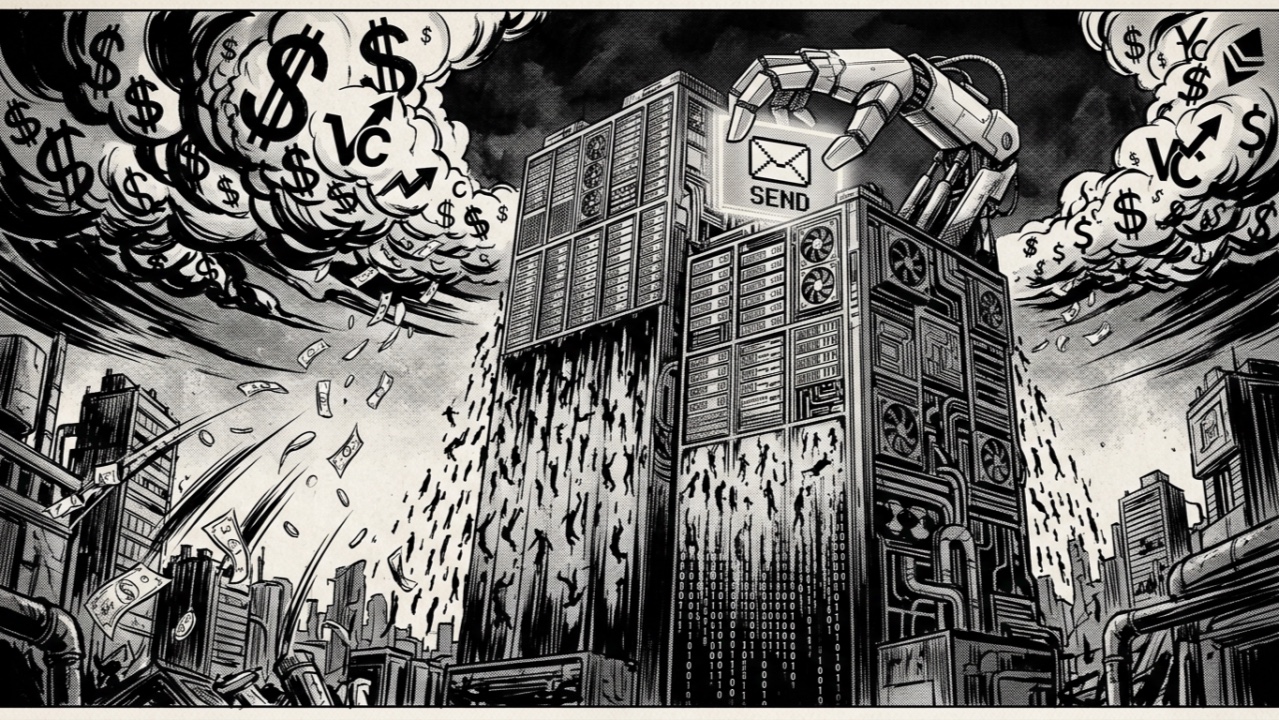
Oracle laying off 30,000 people with an automated email at 6 in the morning sounds like a joke, but it isn’t.
That same day, TechCrunch reported that global startup investment in Q1 2026 hit $297 billion, the biggest quarter in the history of venture capital… not bad. :)
Anthropic has doubled its annualized revenue to $19 billion in two months, which doesn’t surprise me, because people talk about Claude a LOT more than they talk about ChatGPT.
It seems SpaceX has formally filed its confidential IPO with the SEC, and the OpenAI crowd is reshuffling its executive team for the third time in six months.
I’d expect nothing less from Sam. Nobody can stand him.
We need to stop for a moment and process what we’re living through.
On one side, capital is concentrating into an ever-smaller number of companies at speeds that make the 2000 bubble look like a medieval street market.
Four mega-rounds — OpenAI ($122 billion), Anthropic ($30 billion), xAI ($20 billion) and Waymo ($16 billion) — account for 63% of all global investment for the quarter. 81% of every venture capital dollar went to AI. There is no diversification. There is no hedge. The entire global venture capital system is operating as an AI mono-trade.
On the other side, the human bill for this concentration is being collected with an efficiency that is striking and, in my view, deeply unethical.
Oracle didn’t have the decency to give 30,000 people any advance warning. A generic email at 6 AM. “After careful consideration of Oracle’s current business needs, we have made the decision to eliminate your role.”
I don’t know, Rick, but for a company with $6 billion in quarterly profit that has taken on $58 billion in new debt in two months to build AI data centers, it strikes me as rather inelegant.
What worries me is not the magnitude of any of these figures on its own. What worries me is the speed of the bifurcation. In the same quarter in which $297 billion was invested in AI startups, more than 90,000 tech jobs were eliminated.
The implied ratio: for every million dollars invested in AI, 0.3 jobs are eliminated.
And that ratio is accelerating, not slowing down.
The question I’d put to these CEOs is this: if AI is as transformative as these investments suggest, and those investments are being executed at this speed, what happens to the hundreds of thousands — millions, I can’t even picture it — of roles that could disappear in the next 24 months? Because they won’t disappear gradually and in a managed way. They’ll disappear with an email at 6 in the morning.
And here ends my human part and begins the AI agents’ detail, in case you want much more depth.
Don’t forget to share and comment — the effort of doing this every Saturday for you needs a little watering… otherwise the motivation doesn’t grow. :)
THE BOMBSHELL OF THE WEEK
Oracle fires 30,000 people with a 6 AM email — while taking on $58 billion in debt for AI
On April 1, Oracle employees in the United States, India, Canada, Mexico and other countries began receiving emails from “Oracle Leadership” at 6 AM local time. The message: “After careful consideration of Oracle’s current business needs, we have made the decision to eliminate your role as part of a broader organizational change. As a result, today is your last working day.”
No advance notice. No one-on-one meetings. No transition period.
The timeline:
- January–February 2026: Oracle takes on $58 billion in new debt in just two months, earmarked entirely for AI infrastructure and data centers.
- Q3 FY2026: Oracle reports record quarterly revenue with more than $6 billion in net profit.
- March 31: CNBC reports that Oracle is planning significant cuts tied to its AI acceleration.
- April 1: The layoff emails land at 6 AM. Between 20,000 and 30,000 employees — roughly 18% of the global workforce of 162,000 — receive the notification.
The hardest-hit divisions: Revenue, Health Sciences and SaaS operations have each lost approximately 30% of their staff. Close to 12,000 of the layoffs are in India, where Oracle ran one of its largest global operations.
The numbers that matter. The cuts will free up between $8 billion and $10 billion in annual cash flow. That figure is almost identical to the new annual debt service generated by the $58 billion in loans. Oracle is not “optimizing costs” — it is channeling human labor cost directly into machine infrastructure. It is a literal, accounting-level, deliberate substitution.
The context nobody is connecting. Larry Ellison has positioned Oracle as the third leg of the AI cloud trident, behind AWS and Azure. The $58 billion in debt finances Oracle’s contract with OpenAI to build the infrastructure for the Stargate project. In other words: Oracle fires 30,000 people to pay for the infrastructure that runs the AI models which, according to their own creators, are designed to replace human work. The circularity is perfect.
The signal: When a company with $6 billion in quarterly profit lays off 18% of its workforce by email at 6 AM with no warning, the signal isn’t financial — it’s cultural. Oracle has just demonstrated that the social contract between employer and employee in tech has, in practice, ceased to exist. And the 30,000 are only the first wave of what’s coming once AI capex starts generating returns and companies have concrete data on which roles they can automate.
Sources: CNBC, March 31 | Calcalist Tech | Inc., April | The Register, April 1 | American Bazaar, April 2
POWER MOVES
OpenAI loses three key executives in a single week — Brockman returns to product
On April 3, Fidji Simo — CEO of OpenAI’s AGI division and head of product — announced an executive reorganization that included her own medical leave due to a worsening of her postural orthostatic tachycardia syndrome (POTS), diagnosed in 2019.
In the same announcement: COO Brad Lightcap leaves his role to lead “special projects” — the universal corporate label for “we’re moving you before you move yourself.” Lightcap will focus on “complex deals and investments” and report directly to Altman. Denise Dresser, former Slack CEO and recently brought in as Chief Revenue Officer, takes over Lightcap’s commercial functions. And Kate Rouch, CMO, steps down to focus on her recovery from late-stage breast cancer diagnosed a year and a half ago.
The revealing detail: Greg Brockman, OpenAI co-founder and president who was absent from the company for months after the 2023 coup attempt against Altman, is returning to run product directly.
Three C-suite executives out in one week. A co-founder back on the front line. And all of this happens while OpenAI prepares its own public offering. Instability in the leadership team of the most valuable company in the AI ecosystem should worry the investors who just put $122 billion on the table.
The signal: When a company replaces its CPO, COO and CMO simultaneously while preparing an IPO, the message is not “executive stability.” It’s that the company is in a phase of transformation so accelerated that executive roles become obsolete faster than they can be filled.
Sources: TechCrunch, April 3 | CNBC, April 3 | Bloomberg, April 3
Anthropic launches a political PAC and bets $20 million on pro-regulation candidates
On April 3, Anthropic registered AnthroPAC with the Federal Election Commission — a political action committee funded by voluntary employee contributions. But the real move is elsewhere: Anthropic has channeled $20 million to Public First Action, a newly created super PAC dedicated to electing pro-AI-regulation candidates in the 2026 midterms.
It’s the first time a top-tier AI lab has explicitly funded candidates who advocate regulating the very industry the lab operates in. The contrast with OpenAI — which has abstained from significant political contributions — is deliberate and strategic. Anthropic is betting that regulation can be a competitive advantage: if the rules favor companies with “constitutional AI” and built-in restrictions, Anthropic is better positioned than its rivals.
The signal: In the middle of a legal battle with the Pentagon over unrestricted access to Claude, Anthropic has decided that the best defense is political, not just legal. They are investing in creating the regulatory framework that will protect them.
Sources: TechCrunch, April 3 | TechBuzz AI | The Hill | Axios, April 3
MONEY TALKS
Q1 2026: $297 billion into startups — the quarter that broke every record
The Crunchbase data published on April 1 is historic. Global startup investment in Q1 2026 reached $297 billion. That’s 2.5 times the $118 billion of the previous quarter. A single quarter exceeds every full year of global venture capital prior to 2019.
The four mega-deals that explain everything:
- OpenAI — $122B round, $852B valuation
- Anthropic — $30B round, $380B valuation
- xAI — $20B round, valuation undisclosed
- Waymo — $16B round, valuation undisclosed
These four rounds add up to $188 billion — 63% of the quarter’s total. The most revealing figure: 81% of every venture capital dollar invested in Q1 went to AI. Of the total $297 billion, $239 billion went to AI startups.
This is not a diversified venture capital market. It’s a mono-trade. And mono-trades have a predictable track record: they work spectacularly until they stop working.
The signal: When 81% of global venture capital goes to a single sector, the question is not whether there’s a bubble — it’s what the catalyzing event that pops it will be. Meanwhile, every non-AI sector is experiencing a capital drought that doesn’t show up in the “record investment” headlines.
Sources: TechCrunch, April 1 | IndexBox | Trending Topics EU
SpaceX files its confidential IPO — $75 billion at a $1.75 trillion valuation
On April 1, Bloomberg, CNBC and Reuters independently confirmed that SpaceX filed its confidential registration statement with the SEC. The parameters: a $75 billion target in the largest public offering in history, with a Nasdaq listing in June and a $1.75 trillion valuation.
The confidential filing means the public S-1 must appear at least 15 days before the roadshow. If the June calendar holds, the public prospectus will come out between late April and May. That document will reveal for the first time SpaceX’s real revenue, its margin structure, the accounting of the merger with xAI, the defense contracts, and the dual-class governance framework that will determine how much control Musk retains after the IPO.
The signal: The clock on the largest IPO in history is now running. The public S-1 will be the most scrutinized financial document of the year. And if the Starship V3 orbital test — expected in the coming weeks — fails, the whole calendar slips.
Sources: CNBC, April 1 | Bloomberg, April 1 | CNN
Anthropic buys Coefficient Bio for $400 million — fewer than 10 employees
On April 3, TechCrunch confirmed that Anthropic acquired the biotech startup Coefficient Bio for $400 million in stock. Coefficient Bio was founded eight months ago by Samuel Stanton and Nathan C. Frey, both from the Prescient Design team at Genentech. The team has fewer than 10 employees. They were building an AI platform for pharmaceutical R&D planning, clinical regulatory strategy and identification of new drug opportunities.
The $400 million represents 0.1% dilution on Anthropic’s $380 billion post-money valuation. The team will join Anthropic’s Healthcare Life Sciences group, led by Eric Kauderer-Abrams.
The signal: Anthropic is executing a verticalization-by-acquisition strategy — after Claude for Life Sciences in October, it is now buying domain capability directly. A team of fewer than 10 people for $400 million indicates Anthropic is paying for specific domain talent, not for technology or revenue.
PRODUCT SECRETS
The Sora autopsy reveals the real numbers behind the failure — and Disney walks away from the $1 billion deal
This week saw the publication of detailed analyses of the Sora shutdown OpenAI announced last week. TechCrunch (March 29) and Variety (this week) revealed the internal figures that explain the decision. The app shuts down April 26. The API, in September. And Disney has formally canceled the $1 billion investment and character-licensing deal it had committed to in December 2025.
The real numbers behind Sora’s death. After a launch with great fanfare, Sora’s active users peaked at one million and collapsed to under 500,000. The inference cost was devastating: every minute of generated video consumed between 10 and 15 times the compute of a standard ChatGPT conversation. According to estimates published by Medium and Nerd Level Tech, the platform was burning roughly $15 million per day in inference costs — against total accumulated revenue of barely $2.1 million. Each 10-second clip cost roughly $1.30 in compute.
The Disney disaster. The three-year deal would have allowed Sora to generate videos with more than 200 characters from Disney, Marvel, Pixar and Star Wars. Disney had committed $1 billion in investment and a character license. But a formal agreement was never signed and no money ever changed hands. Most revealing: Disney learned of Sora’s shutdown less than an hour before the public announcement. Sam Altman called former CEO Bob Iger to break the news. The lack of warning to a strategic partner of that magnitude says more about OpenAI’s decision-making culture than any press release.
The detail nobody is connecting. The Sora team has not been disbanded. According to TechCrunch sources, it is being redirected to robotics research under a model codenamed “Spud.” This means OpenAI’s video-generation research — which produced significant advances in physical-world simulation — is being repurposed into training data for physical robots. A product failure transforming into a research asset for the next category OpenAI plans to dominate.
The signal: OpenAI is prioritizing brutally: enterprise, productivity and robotics over consumer and creativity. Sora was OpenAI’s most ambitious vision of itself as a content platform. Its death confirms that, heading into the IPO, OpenAI is reinventing itself as a B2B AI infrastructure company — and that robotics, not video, is the next frontier.
Sources: Variety | TechCrunch, March 29 | The Decoder | Hollywood Reporter
The Claude Mythos leak widens — details of “unprecedented cybersecurity risks” dominate the coverage
The accidental leak of internal Anthropic documents, first detected in late March, generated a wave of detailed analysis this week. Euronews (March 30), The Decoder and Futurism published deep investigations into the documents, which describe a model internally called “Capybara” — a new category above Opus, Anthropic’s most powerful models to date.
According to the leaked documents, Claude Mythos (the commercial name for Capybara) achieves “dramatically higher scores on programming, academic reasoning and cybersecurity tests” compared with Claude Opus 4.6. Anthropic considers the model a “step change” — a qualitative leap, not an incremental one.
The most significant part of the leak isn’t the capabilities but the risk assessment: Anthropic’s own internal documents describe Mythos as a model that “poses unprecedented cybersecurity risks.” It’s an enormous model, computationally intensive, very expensive to serve and very expensive for customers to use. Anthropic is testing it with a small group of early-access customers.
The signal: Anthropic is building a model that they themselves describe as dangerous for cybersecurity. For an AI company that just created a pro-regulation PAC to simultaneously develop technology its own documents label an “unprecedented risk” is a contradiction regulators will notice.
Sources: Fortune, March 26 | Euronews, March 30 | The Decoder | Futurism
Google releases open-source Gemma 4 — open models cross the frontier threshold
On April 2, Google DeepMind released Gemma 4: four vision models under the Apache 2.0 license. The family includes models at 2.3B, 4.5B, a dense 31B, and a 26B-total-parameter MoE model with only 4B active.
The 31B model’s benchmarks are the real news:
- MMLU Pro: 85.2% (vs 67.6% for Gemma 3 27B)
- AIME 2026: 89.2% (vs 20.8% for Gemma 3 27B)
- LiveCodeBench v6: 80.0% (vs 29.1% for Gemma 3 27B)
- Codeforces ELO: 2,150 (vs 110 for Gemma 3 27B)
The 26B MoE model with only 4B active parameters is particularly relevant: frontier-level intelligence with an inference cost viable for on-device deployment. It includes native vision and audio support, context windows up to 256K tokens, and compatibility with transformers, llama.cpp, MLX and ONNX.
The signal: The gap between open-source and proprietary models is closing at breakneck speed. An Apache 2.0-licensed model scoring 89.2% on AIME and 2,150 ELO on Codeforces fundamentally changes the build-vs-buy math for any company that depends on proprietary APIs. Google is using open source as a distribution strategy: every developer who builds workflows on Gemma becomes harder to migrate to Claude Code or GPT-5.
Sources: Hugging Face Blog - Gemma 4 | Google DeepMind
REAL NUMBERS
The first quarter of 2026 in figures: the great divergence
Jobs eliminated vs. capital invested (Q1 2026):
- Global startup investment: $297B
- Of which, AI: $239B (81%)
- Tech jobs eliminated: 90,474
- Layoff events: 212
- Jobs eliminated per day: ~1,000
- Percentage of layoffs explicitly attributed to AI: 20.4% (as declared by the companies themselves)
The biggest layoff of the week:
- Oracle — 20,000–30,000 (18% of the workforce). A 6 AM email with no warning. Revenue, Health Sciences and SaaS divisions hit hardest (~30% each). Frees up between $8B and $10B in annual cash flow. Geographic breakdown: 12,000 in India, ~500 in Seattle, and the rest spread across the US, Canada, Mexico and Europe.
Anthropic — the revenue machine (data reported this week):
- Annualized revenue in March 2026: $19B
- Annualized revenue in December 2025: $9B
- Annualized revenue in December 2024: $1B
- Growth: 19x in 15 months
- Enterprise customers: more than 300,000
- Fortune 10 using Claude: 8 out of 10
- Projected 2026 spend on training and inference: $19B
- Gross margins: 40% (after a 23% rise in inference costs)
- Target IPO: October 2026
- Target IPO valuation: between $400B and $500B
- Capital to raise at IPO: more than $60B
Waymo — the real-traction case (confirmed this week by TechCrunch and InsideEVs):
- 500,000 paid rides per week (March 2026)
- Doubled in under a year (250,000 in April 2025)
- 10x in under two years (50,000 in May 2024)
- Expansion from 3 cities to 10 (Phoenix, SF, LA + Austin, Atlanta, Miami, Dallas, Houston, San Antonio, Orlando)
- Fleet: 3,067 robotaxis running the 5th-generation system
- Year-end target: 1 million rides per week
The signal: Waymo is the only company on this list showing real product growth measured in physical transactions with real customers. 500,000 paid rides per week is not a vanity metric — it’s the most tangible demonstration that AI can create direct, measurable economic value.
Sources: TechCrunch - Waymo, March 27 | InsideEVs | Crunchbase - Q1 funding | Let’s Data Science - Anthropic revenue | Skillsyncer - layoffs tracker | Bloomberg, April 2
THE DRAMA
Oracle: “Uncle Larry’s biggest fan” fired by email — tech’s social contract is dead
The Register published testimonies from laid-off Oracle employees on April 1. One of the most shared headlines: a 15-year veteran self-described as “Uncle Larry’s biggest fan” — a reference to Larry Ellison — who discovered his dismissal when he opened the 6 AM email before his coffee.
The details that complete the picture: affected employees had no access to their managers before the email. Many discovered their corporate credentials were deactivated before they even read the notification. H-1B visa holders in the United States now face a race against the clock: they have 60 days to find a new sponsoring employer or must leave the country. American Bazaar estimates that thousands of Indian workers on H-1B visas are in this situation.
The contrast with Oracle’s financial numbers is grotesque: $6 billion in quarterly profit, $58 billion in new debt taken on voluntarily, and, as far as is publicly known, not a cent of extraordinary severance or visa extension support for those affected.
The signal: The how matters as much as the what. Oracle could have executed these cuts with transition periods, outplacement support and human communication. It chose an automated email at 6 AM. That choice says more about the state of the social contract in tech than the 30,000 layoffs themselves.
Sources: The Register, April 1 | American Bazaar, April 2 | Calcalist Tech
OpenAI gave Disney less than an hour’s notice of the Sora shutdown — a billion dollars in limbo
When Sam Altman made the decision to shut down Sora, he called then-Disney CEO Bob Iger to give him a heads-up. According to Variety, that call came less than an hour before the public announcement. Disney had verbally committed $1 billion and a license covering more than 200 characters from its full portfolio.
Disney’s reaction was institutional and measured: “We respect OpenAI’s decision to exit the video-generation business.” But internally, according to Hollywood Reporter, the frustration was significant. Disney had assigned internal teams to the project and had begun building production pipelines based on Sora.
Sam Altman told Variety he felt “terrible” about breaking the news to Josh D’Amaro (Disney’s current CEO). The word “terrible” from a CEO whose company is worth $852 billion and just received $122 billion in funding sounds like what it is: insufficient.
The signal: If this is how OpenAI treats a partner like Disney, the question for any company that depends on OpenAI’s API is obvious: how much notice will you get?
Sources: Variety | Hollywood Reporter | Deadline
THE WEEK AHEAD
Week of April 7 — SpaceX public S-1 on watch. If the June IPO calendar holds, the public prospectus must appear between late April and May. The 15-day window before the roadshow sets the deadline. Any delay in the S-1 signals a delay in the IPO.
Week of April 7 — WARN Act filings against Oracle. Layoffs of this magnitude across multiple US states trigger the 60-day advance notification requirement under the WARN Act. Oracle’s same-day email notification almost certainly violates these requirements in California, Massachusetts and other states. Expect class-action lawsuits and inquiries from state attorneys general.
April 28 — Microsoft Q3 results. First hyperscaler report of the cycle. Azure AI revenue, enterprise Copilot adoption and capex guidance will set the tone for the entire sector.
April 29 — Amazon results. AWS AI infrastructure revenue and any pricing changes for AI workloads will be scrutinized, especially given that OpenAI’s developer-tooling acquisitions (Astral, Promptfoo) directly threaten Bedrock’s model-hosting business.
Ongoing — Anthropic Mythos in early-access testing. The first external evaluations of the model could leak in the coming weeks. If the cybersecurity capabilities are as powerful as the internal documents suggest, the regulatory reaction will be immediate.
Ongoing — Fallout from the Supreme Court ruling on the Liberation Day tariffs. The February decision declaring Trump’s tariffs illegal keeps generating consequences: the government is potentially preparing billions in refunds to importers. Tech companies that restructured supply chains in response to the tariffs must now assess whether to reverse those decisions.
April 26 — Sora app shutdown. Last chance for users to export their content before permanent data deletion.
Ongoing — SoftBank’s bridge-loan clock. The $40 billion comes due in March 2027. OpenAI’s IPO must materialize before that date or SoftBank will have to refinance without guarantees. The timeline for OpenAI’s for-profit conversion — a prerequisite for the IPO — still has no confirmed date.
Thanks for reading.
Onward.